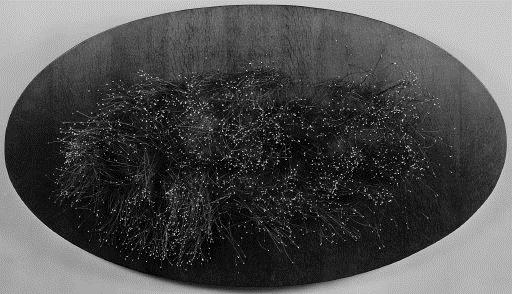
I entered the Tate Modern’s Electric Dreams: Art and Technology Before the Internet exhibition looking for computer art. But the most compelling work in the exhaustive fifteen-room show was a low-tech sculpture made of wood, nylon, and a motor. 3069 White Dots on an Oval Background, made in 1966 by the Belgian sculptor Pol Bury, was a wall-mounted wooden oval with tufts of brushy nylon wires emerging from it. Next to it was a note that read This work stays on for 30 seconds then stops for 30… The movement is very subtle. Two museum-goers conferred: “Did you see anything?” Apparently not. “It must be broken,” one announced, departing. I stayed and waited. Then: a barely perceptible shudder through the wires, like an insect scuttling through tall grass.
Works like Bury’s discreetly invite attention, instead of demanding it. And they recall a time when working at the intersection of art and technology was a physical affair—involving motors, gears and circuits—not a digital, dematerialized one. Electric Dreams wasn’t, strictly speaking, an exhibition of computer art. Instead, it showed how the twentieth century was shaped by computing and cybernetic ideas, even if artists weren’t sitting in front of a screen.
Indeed, many of them couldn’t: the first computer with a monitor appeared in 1973. Electric Dreams began its chronological survey in the ‘50s, when computers were room-sized monstrosities used for military and scientific endeavors, not art. Ben Laposky’s Electronic Abstraction 4 (1952), with superimposed waveforms, twisted and glowing on a cathode-ray screen, may look like today’s Processing sketches, but it was made on a voltage testing instrument, not a computer. The situation hadn’t improved much by the ‘60s, when the computer scientist Leslie Mezei lamented that “No facility exists…where artists can work on a regular basis at an ‘art machine.’” The earliest computer art was made by those whose day jobs let them encounter and experiment with computers.
Electric Dreams included three works by Hiroshi Kawano, a philosophy professor who learned to program at the University of Tokyo’s computer center. KD 29 (1969) is an exuberant composition of teal, fuchsia, cerulean, and yellow blocks, thickly outlined in black. It’s part of Kawano’s Artificial Mondrian series: pseudo-random compositions generated with a computer and hand-painted with gouache. The abstract expressionist Robert Mallary’s Quad III (1969), one of the first sculptures designed with a computer, was another mainframe-era work that was computationally designed and manually produced. Mallary wrote a program to generate the size and shape of the sculpture’s thin plywood layers, and then assembled them into a tall, vaguely humanoid form. The sculpture’s polished figure, with the vertical slices forming a head, neck, chest, and hips, is reminiscent of contemporary 3D-printed works.
Two of the most mesmerizing works were made by engineers turned artists. For Wen-Ying Tsai’s Cybernetic Sculpture: Square Tops (1969), thin metal wires, suspended vertically and gently vibrating, shimmered in a dark room as a strobe light flickered on and off. The strobe’s frequency was controlled by a microphone attuned to the voices and footsteps of museum-goers. Tsai had encountered strobe lights in engineering school, but it was only after he quit his day job (as an architectural engineer for Bauhaus pioneers Mies van der Rohe and Walter Gropius) that he turned away from traditional paintings and embraced technological art. Vladimir Bonačić also trained as an engineer, and headed a cybernetics lab in Zagreb. Electric Dreams presented three of his sculptures, made in 1969: large aluminum frames, with lights arranged in a sparse grid and custom hardware and software inside. Pressing down on a foot pedal activated a rapid, dazzling sequence of lights. Bonačić, who was skeptical of the artistic utility of pure chance, modeled the lights after Galois fields, an abstract algebraic concept often used in cryptography.
The later rooms included works made entirely with computers, like Suzanne Treister’s Fictional Videogame Stills (1991–2), which was created on the Commodore Amiga 1000. Her cheerfully garish, pixelated landscapes—with ‘90s-era system alerts superimposed over them—are rendered in authentically Y2K colors and low-resolution edges. Because the original files were stored on corrupted floppy disks, Electric Dreams resorted to a reproduction: Treister’s photographs of her computer screen, scanned and digitized. Newer digital artworks are, it seems, more vulnerable to decay than the older, self-contained sculptures by Tsai and Bonačić.
Some recreations, however, improve upon the original. I entered the room devoted to Carlos Cruz-Diez’s Chrominterferent Environment (1974–2009) to see striped lines, spring green and yellow, projected on the white walls. Enthusiastic children and performatively listless adolescents congregated here. The lines distorted as they draped over the white cubes and inflated balls scattered throughout the room, ready to be pushed, kicked, and rolled. This Chrominterferent Environment was a recreation of Cruz-Diez’s original work—a recreation that showcased technology’s advancement, not degradation. Cruz-Diez first installed this work at a Venezuelan art museum in 1974, using a slide projector and 35mm film painted with gouache. But he couldn’t achieve the chromatic complexity he wanted. Decades later, his son helped him recreate Chrominterferent Environment with high-definition video projectors and code. The result was arguably more original than its predecessors, and more accessible to audiences in the present.
The exhibition’s greatest weakness—an overly broad scope—was also its strength. Most histories of computing are situated in Bletchley Park, Geneva, Palo Alto, and Boston; most art histories, in New York and London. But Electric Dreams insisted on an international approach—and, in doing so, shed light on the vital work happening in places like Zagreb. From 1961 to 1978, the city was home to the avant-garde New Tendencies movement, which included Bonačić, Kawano, Mezei, and others. Yugoslavia was a socialist state, but its non-aligned status during the Cold War meant that the arts could develop “free of ideological state interference,” as the Austrian curator Armin Medosch observed. As a result, New Tendencies could bring together a multidisciplinary, multilingual group of artists from the East and West. Bit International, the movement’s magazine, printed each article in two languages: Croatian on the left, and another language (typically English, French or German) on the right.
In the end, New Tendencies produced five exhibitions, one symposium, and eight issues of Bit. It brought together artists and intellectuals whose projects were often illegible to their contemporaries. Critics tended to be hostile to early computer art; it was, as the art historians Hannah B. Higgins and Douglas Kahn observed, “synonymous with ‘bad art’ or, more generously, an immature or technologically defined aspirant art.” Computer artists weren’t just on the fringes of the art world; they were on the fringes of the computing world, too: a “somewhat illegitimate subculture,” Leslie Mezei acknowledged, of “the wider field of computer graphics”. The artists and intellectuals featured in Electric Dreams forged ahead anyway.
But computer artists weren’t working in isolation. Then, and now, computer art had much in common with the more venerated Conceptual art movement, which emerged in the ‘60s alongside mainframe computers. For Conceptual artists, “the idea is paramount,” the critic and curator Lucy Lippard declared, “and the material form is secondary, lightweight, ephemeral…or ‘dematerialized.’” To preserve the immaterial “idea” of a work, artists emphasized documenting their processes and performances—an approach that digital art preservationists also use. “Documentation,” the conservationist Dragan Espenschied wrote in 2022, “fill[s] the gaps in between manifestations of a piece…[and] specific types of documentation can become part of an artwork’s manifestation.”
In 2014, Espenschied was appointed director of digital preservation at Rhizome, an organization founded by and for new media and digital artists. “My background,” Espenschied acknowledged, “is as an electronic musician and internet artist; I am not a trained librarian or archivist.” His practice, however, has focused on making born-digital art and culture accessible. One Terabyte of Kilobyte Age is a collaborative archiving project with the net art pioneer Olia Lialina, who has sought to “preserve the beauty of the vernacular web”—the exuberantly amateurish websites made by early web adopters in the mid-to-late 1990s—“by integrating them within contemporary art pieces.” When the influential web hosting service GeoCities was shut down in late 2009, Espenschied and Lialina began digging through a terabyte-sized torrent of GeoCities webpages—saved by a volunteer archiving collective—and sharing screenshots on a widely followed tumblr, treating these sites as part of the internet’s cultural heritage and incorporating them into contemporary artistic discourse.
Espenschied also collaborated with the new media artist Cory Arcangel to preserve and disseminate the work of Michel Majerus, whose paintings incorporated digital motifs. Through Espenschied’s emulator, Arcangel booted up Majerus’s old MacBook and began exploring the late painter’s folders and files—and documenting it in a four-part “Let’s Play Majerus G3” series on YouTube. “I have an enthusiasm for contemporary art” Arcangel told Spike. “I want to communicate [it] to as large an audience as possible.” To honor Majerus’s influence on his own work, Arcangel has also curated exhibitions that place their artworks side by side.
Espenschied and Arcangel’s approaches—alongside projects like Mindy Seu’s Cyberfeminism Index of influential and under-recognized texts and works, as well as the artist and technologist Chia Amisola’s Philippine Internet Archive, which collects Filipino internet artifacts—reflect an artist-archivist strategy of making history contemporary again, incorporating older works into new contexts.
“In order for artifacts to survive culturally,” Espenschied said in an interview, “they need to become useful again in contemporary digital culture.” Too often, he lamented, “conservation is done by removing artifacts from the cultural tempest they originated in and putting them into a safe place.” Espenschied takes a different approach: reimmersing and reintegrating historical artifacts into contemporary contexts. “A digital conservator,” he reflected, “will need to weave the past into the present and constantly find new ways of doing so.”
Digital artworks are challenging to conserve because they exist not just in a social context—where viewers interact with, participate, and thereby contribute to the work—but also a technical context, requiring specific hardware and software. Commissioned by the Guggenheim Museum and published online in 1998, Shu Lea Cheang’s seminal net artwork Brandon was a website with different narrative installments and participatory features (including an online chat) that explored gender identity in the physical and virtual worlds. By 2016, however, the website, which relied on outdated and deprecated web technologies (including Java applets and <marquee> tags) was broken. To restore the piece, the Guggenheim’s conservation department worked with Deena Engel, a computer science professor at NYU, and Engel’s student Emma Dickson. Dickson commented out old, defunct code, ensuring that “the unique and characteristic tone” of Brandon’s code would be retained. Newer code was committed to a private GitHub repository, so changes could be clearly tracked. To restore certain functionality, the conservation team also interviewed Cheang and the programmers who worked on Brandon—and went through Cheang’s archives to learn about her research and process. The “reanimated” site was then documented in a 24-minute YouTube video, narrated by Dickson.
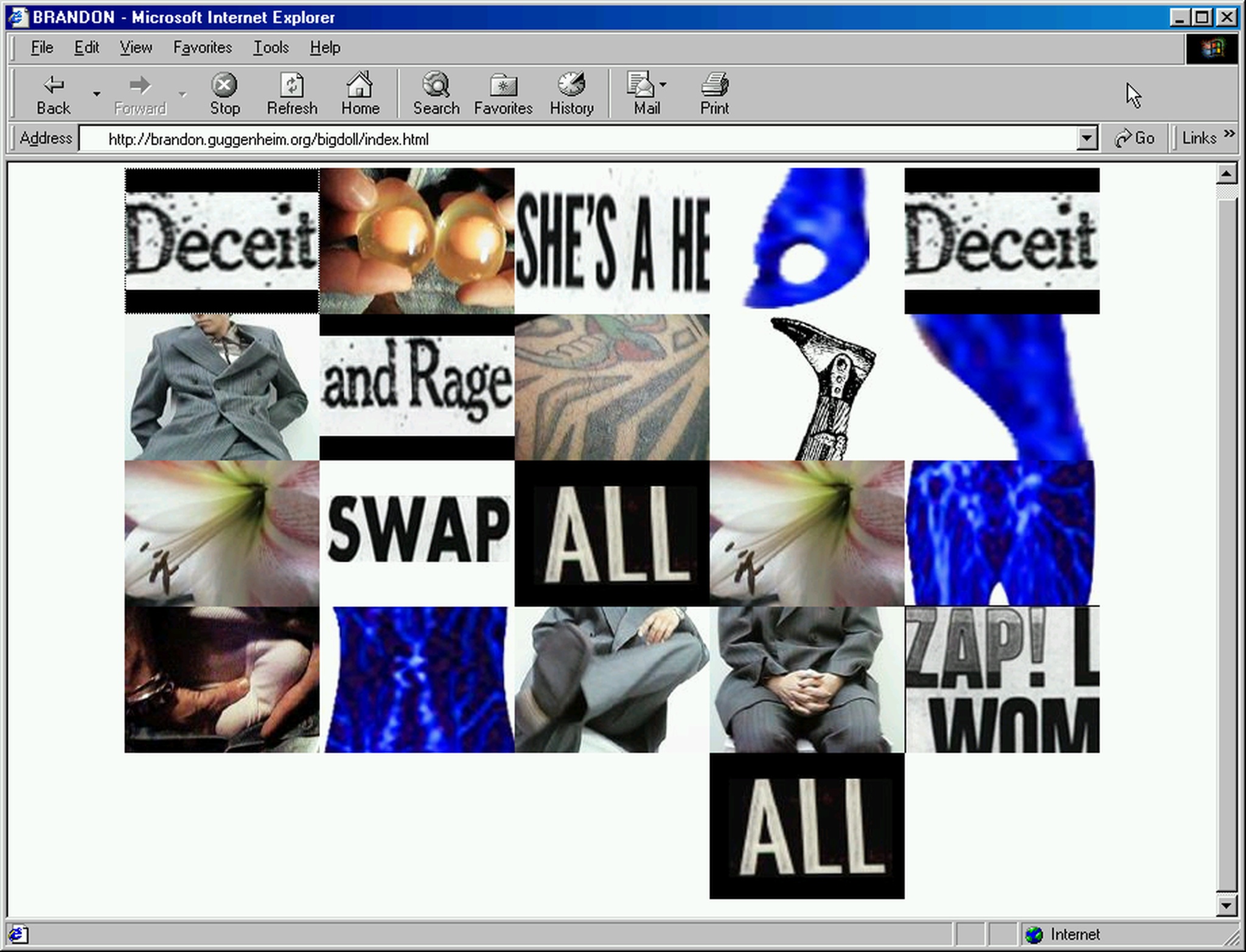
Cheang named her work after Brandon Teena, a trans man whose story reflects the importance of writing—and rewriting—certain histories. In 1993, after Teena moved to a small Nebraskan town and began dating a woman, he was outed as trans and murdered. The 1999 film Boys Don’t Cry, which brought Teena’s story and questions of trans identity to a broader audience, is based on the groundbreaking reporting that Donna Minkowitz did for the Village Voice. Minkowitz, a lesbian, treated Teena with tremendous sympathy in her piece—but she also chose to frame him as a woman who was living as a man to escape homophobia. Twenty-five years later, Minkowitz revisited her approach: “Where I went wrong,” she wrote, “was to deny transness as a real possibility for…Brandon…and the way in which he most consistently told his intimates he wanted to be seen.” By acknowledging her missteps, Minkowitz sought to make a reparative gesture. “We are in a time of enormous cruelty in the body politic,” she went on, “a time when rebuilding solidarity is the most precious task we have.” Revising the story was her “way of making amends.”
It’s not lost on me that I’m writing about Cheang’s Brandon at a time when the body politic has only become more hostile to trans people. In February 2025, weeks after Trump’s second inauguration, the website for the Stonewall National Monument, which is maintained by the National Park Services, was updated to remove all mentions of trans involvement in the 1969 uprising. Similarly, the “T” was conspicuously removed from any mention of “LGBTQ.” Other government websites, like the Centers for Disease Control’s, were scrubbed of trans and queer healthcare information, prompting “a loose coalition of librarians and archivists,” as Julien Lucas reported in the New Yorker, to begin downloading and backing up data. What’s at risk isn’t just the well-being of trans people today, but their presence in the historical record, and any sense of continuity between past and present.
Much of the trans and queer activism of the last decade has demanded greater recognition from mainstream institutions, including museums and governments. These recent erasures, however, suggest that counter-archival practices will always be necessary, especially for marginalized communities. These community archives might include artworks that incorporate certain stories and experiences into an aesthetic, narrative form. When I interviewed Dickson about their work restoring Cheang’s Brandon, they noted that the artwork—as well as Cheang’s archives—taught them about the longer history of trans people in America. Restoring Brandon’s pages, which included references to people like Jack Bee Garland (a trans man born in 1869) gave Dickson a “foundational understanding…[of] trans criminalization and medicalization” in the United States. The amateur artist-archivist may, in the end, be the primary—or only—way we learn about certain stories. Even those who have entered into institutional roles recognize this. In a 2014 interview, Espenschied said, “I see my personal role as ultimately developing methods and practices for communities to take care of their own history.”
The question of handling history—or, more literally, managing memory—has plagued programmers for decades. Early computers had limited memory, and programmers were responsible for managing what information needed to be retained for later use, and what could be deleted to free up space. But in 1959, the computer scientist John McCarthy added automatic memory management, known as “garbage collection,” to the programming language Lisp. Other languages eventually followed. There are several strategies to implement garbage collection, but the most common—tracing which information has been referenced elsewhere, or counting the number of references—is similar to how a historian might work. To remember something about the past, you need a reference to it—a pointer, as a programmer would say—to lead you there. The more references something has, the more meaningful it seems to be.
The flip side of this is that information with zero references is vulnerable to deletion. Lack of attention is a death sentence. Attention, then, is how we keep something alive in memory: Brandon Teena’s story, Shu Lea Cheang’s Brandon, early computer art, bygone ideals. And attending to something also transforms us, shaping how we understand our past, present, and potential futures.
Attracting the right kind of attention in today’s chaotic, information-saturated culture can feel daunting. But one pointer—one person—can be enough to retain something in memory. It was Donna Minkowitz’s interest in Teena’s story that led to Boys Don’t Cry and the other works that kept Teena’s story alive. And our understanding of the New Tendencies movement has also been shaped by one man’s attention. Since 2000, the Croatian artist Darko Fritz has been researching, writing, and curating exhibitions about the movement. For the exhibition I Am Still Alive, which opened in Zagreb, he chose to focus on the “low tech” of the past. “I’m interested,” he wrote, “in the politics behind such a gesture…the refusal to take…technological progress for a given.” His peers took notice; in 2007, after a New Tendencies exhibition was brought to Austria and then Germany, the curator Armin Hoffman described New Tendencies as “the ultimate avant-garde,” and noted that their work would have been “almost lost” without Fritz’s tireless advocacy.
What’s striking about New Tendencies is how many technological anxieties they anticipated—and sought to address. The second issue of Bit International includes an essay by A. Michael Noll, who trained as an engineer and made some of the earliest computer artworks during his 15 years at Bell Labs. The essay wouldn’t be out of place in a contemporary debate about AI art: “In the computer,” Noll writes, “man has created not just an inanimate tool but an intellectual and active creative partner.” Creating art this way, he acknowledged, “may seem a little strange…[as] creativity has universally been regarded as the personal and somewhat mysterious domain of man…Nonetheless, artists have usually been responsive to experimenting with…new scientific and technological developments. Computers are no exception.”
Noll’s techno-optimism was balanced out by the cautious approach that the scientist Zdenko Šternberg took in the following issue of Bit International. Anticipating later concerns about AI slop, Šternberg asked:
“To what extent is it justifiable to liken the creative intuition to randomness (chance) that is produced by a relatively simple electronic circuit?…
These and other questions require an urgent reply because of the vast productive capacity of computers. It is desirable that we should not be swamped one day…by the machine-made deluge of kitsch.”
Šternberg’s suggestion was to keep humans in the loop. It will “remain essential and vital,” he wrote, for artists to “intervene in the formulation of the original idea and especially in discriminating between worthy and worthless results.” The ambient musician and cybernetics enthusiast Brian Eno has advocated for something similar; in December 2024, he wrote: “To make anything surprising and beautiful using AI…you need to rigorously filter the results.” Our predecessors, it turns out, confronted many of the same problems that we have.
I’m reminded of the feeling that John Berger once described as “historic loneliness,” which emerges when “analyses and commentaries about events…start their accounts too recently…[and] any sense of History, linking past and future, has been marginalized, if not eliminated.” The artists and texts in Electric Dreams remind us that many of our problems aren’t novel, and we’re not alone in facing them. Keeping their works alive can help us articulate the artistic and technological future we want to have.
Still, something has been lost between the decades featured in Electric Dreams and now. Many of the works at the Tate Modern were produced at a time when artists were unambiguously excited about the “new possibilities” of computer art—which could be realized, Leslie Mezei argued, if “serious artists…take an interest and join the technologists in exploring this new medium of expression.” Today, the relationship between artists and technologists seems more antagonistic than collaborative, especially as generative AI threatens the livelihoods of working artists and writers. The past seems like a long-foreclosed utopia—if we’re even able to remember it. The newly precarious existence of the Internet Archive, which was meant to save websites from oblivion, suggests that the received wisdom of the early 2000s (The internet is forever) is tragically false.
There’s a passage I often return to, in the final volume of the science fiction novel The Three-Body Problem, written by the Chinese engineer and writer Liu Cixin. A character named Luo Ji is chairing a committee for the Earth Civilization Museum, which is trying to preserve humanity’s cultural output “across geologic eons.” The committee considered several different technologies:
“Scientists…found some USB flash drives and hard drives…and some still had recoverable data! Experiments showed that if these devices were of high quality, information was safe on them for about five thousand years. The optical disks from our era were especially resilient…[and] could reliably preserve data for a hundred thousand years.”
But the most reliable storage devices, they discovered, were the oldest ones. Flash drives and CDs, Ji said, “were [no] match for printed material. Special ink printed on composite paper could be read in two hundred thousand years.” And humanity’s oldest surviving art used even more primitive tech: “Cave paintings in Europe were from about forty thousand years ago.”
Using older information technologies means trading storage capacity for longevity. In writing about Electric Dreams for this magazine, I’m compressing a high-dimensional experience into a lossy format. You can’t walk through the rooms with me, see the motors shift, the lights flicker, the screens glow. But this compressed representation of the exhibition can go places the exhibition can’t. This text can be photographed, scanned, OCRed. Flying overseas to see Electric Dreams is costly; shipping this magazine to you is cheap. In encoding this exhibition in print, I’m making a bet that the codex—one of the oldest information technologies we have—is going to outlast many of the others we’ve come to rely on. By the time you read this, the Tate Modern’s exhibition will be closed. But perhaps this text can be a pointer to the past—and to the artistic and technological stories worth remembering. ◼