The process of creation has always felt like an exploration: non-linear and filled with doubt. One presses forward cautiously with one hand outstretched, like Lucy in the darkness of the wardrobe, snow creaking underfoot—the way alternating between uncertainty and ease.
There are moments in painting when every muscle seems strained towards the delicate point of the brush, when the movement of the arm begins at the shoulder and continues downwards, from bicep to forearm, into the wrist, from those slender sinews into the fingertips and through the brush in fine strokes—the physical manifestation of thought and feeling, energy moving from the figure to the page. To the well-practiced athlete is given the same untroubled instinct as an accomplished artist, the body moves intuitively before the mind can weigh it down.
But for each of these moments of fluidity comes others, when in carelessness one goes too far, ruining a work irreversibly, or in less extreme instances, simply creating moments that only the artist knows about, sticky points invisible to outsiders which fill its creator with regret. For many works, I can remember those moments keenly. A few years ago, working in my Zurich studio late in the night on a letter to be mailed in the morning before I flew back to the US, I became convinced that the soft layers of gouache in blue and flaxen hues should be offset by a black background. The effect was ruined. Around 2am I put it into a drawer in which many other works have been laid to rest and started again.
For years now and for many reasons, I’ve been thinking about the birth of the internet and the development of virtual space. Born in 1989—the same year the World Wide Web was created—my early internet experiences often felt like an echo of my own development, as if the two of us were growing apace. There must have been a correlation between the simple, colorful graphics on the first Power Macintosh my father brought home in 1995 and my predilections as a kindergartener living in primary colors. Even the evolution from the simple operating systems and online searches of middle and high school to the vast expanse of information I now trawl through, uncertain of what is real or true, sometimes feels like the shift of my own understanding of the world and its multiplicities. But there was also the legend of its birth, which I pieced together over the years—the invention of the virtual realm as an exercise in storytelling, a psychological space shaped through words and ideas.
Beyond its physical-virtual interface, the Web exists in our imaginations, a space fabricated from its existing systems and our spatial understanding as bodied beings, for in spite of its manifold functions, only human imagination could have rendered this network of code into a place. The black rectangle disclosing replies becomes a room in which we stand in the dark with another person, speaking mind to mind. A web page or social media account manifests as a storefront window displaying a selection of wares. Yet, though they are now linked, the creation of this virtual space preceded the birth of the internet or the World Wide Web.
In his seminal work of philosophy, The Production of Space, Henri Lefebve writes, with great feeling, “Epistemologico-philosophical thinking has failed to furnish the basis for a science which has been struggling to emerge for a very long time, as witness an immense accumulation of research and publication. That science is—or would be—a science of space.” Lefebvre argued that there was at present no system to analyze the numerous connections between the planned use of a physical space, its actual embodiment through social behavior, and the way it is felt and remembered over time.
The Production of Space is one of the most influential books on my practice as an installation artist, opening the door to the psychology and ethnography of space. In earlier readings I felt he was overly exacting in trying to create systems to pin down something so multifaceted and indefinite. Now, I dwell more on his many unanswered questions than his proposed systems. The book shares some kinship with Italo Calvino’s novel, Invisible Cities. As Marco Polo recounts the numberless faces of Venice, so too does Lefebvre meditate on space as it changes through time, capitalism, and technocracy, prospecting shades of its meaning like a man peering through the myriad planes of an endless crystal.
Lefebvre places the dreams of space in art and literature under his category of lived space. Against the conventions of conceived space—what was planned and intended by architects and governments—and perceived space—the resulting sphere shaped through social use—lived space stands as a place of possibility and perhaps resistance against what is, opposed to what could be. But Lefebvre’s system reaches its limits in the dissemination of virtual space. What I believe lies at the heart of the creation of virtual space is the process of dreaming, and even more significantly, of collective dreaming. It is that speculation which fascinates me, the reaching forward into the gloom without knowledge of what lies ahead. Perhaps this collective dreaming is akin to the Situationist practice of the dérive, the act of wandering or drifting through the city without aim, often done in groups. In this unconscious collective passage, sensitive to every shift in psychogeography, it seems impossible to identify exactly who is leading who or if all bodies simply moved, involuntarily, as one.
Virtual space emerged from science fiction as early as the 1930’s from the minds of not one, but two different writers, Laurence Manning and Stanley G. Weinbaum, before any real supporting technology existed. Manning’s 1933 novel, The Man Who Awoke introduced a future in which people could choose to live in a dream of their choosing simulated by machines. “As to the practical matters, such as pleasures and necessities, the dream machines give one a better life than nature or chance could offer,” concludes Eric, a young scientist who tends to the machines. Stimulated by electricity, the body lives until the age of its natural death, but slowly withers to resemble an Egyptian mummy. Two years later, Stanley G. Weinbaum published the short story "Pygmalion’s Spectacles," in which a man on a business trip meets a professor who offers him a living movie, a dream made real through a goggled mask which uses electrolysis to activate the liquid in the lenses. These early portrayals seemed most inspired by dreams, but perhaps the concept of virtual space was an inevitability for a human civilization so influenced by religion. It was no great leap from imagining alternate worlds created by gods to alternate worlds created by humans wielding machines or the machines themselves.
For me, one of the most defining portrayals of virtual space is crystallized in William Gibson's novel, Neuromancer, which appeared as network technology was just beginning to take shape. Published in 1984, only a year after the internet was first officially created through TCP/IP packet switching protocols, Neuromancer dreamt of a three-dimensional pictorial rendering of data, a landscape of grids, towers, and symbols which Gibson christened “cyberspace.” It was an image that entered our collective consciousness much like his own description of it, “a consensual hallucination experienced daily by billions of legitimate operators, in every nation.” At a time when the first computers were only transferring text—the first emailed image would not be sent until 1992—Gibson’s fully formed cyberspace, in which one could “jack into” a semblance of their own body, was in part influenced by the aesthetic of Tron, a Disney film which came out in 1982 as Neuromancer was in its first drafts. In Tron, a software engineer is digitized and uploaded into the world of a gaming platform where he interacts with living, reasoning programs. The visuals, stemming from the limited computer graphics of that time, imagined a virtual world of light lines and grids against the darkness.
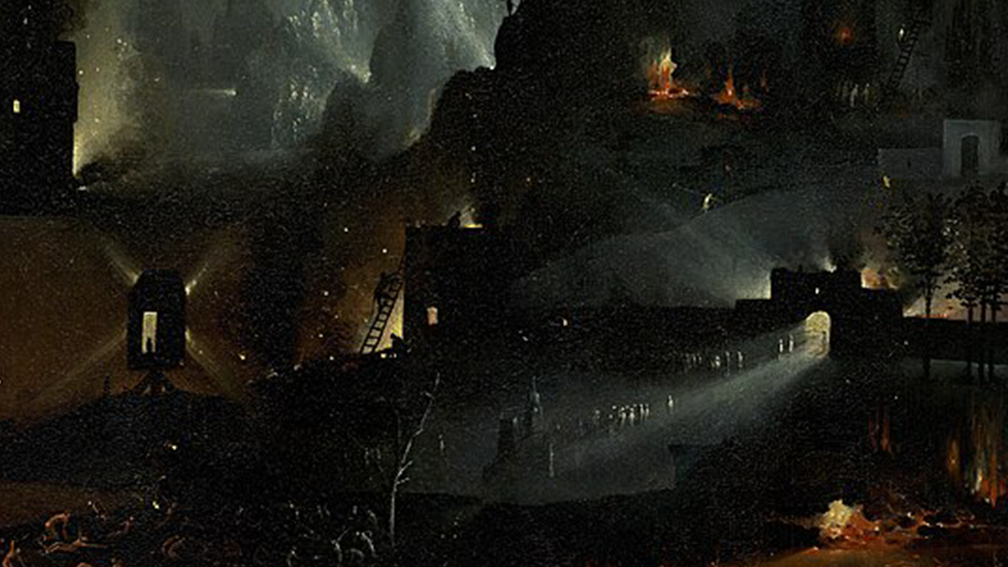
That these worlds emerged from darkness, echoing the Latin phrase, ex nihilo, or the creation of something “out of nothing” is suggested in many depictions of virtual space, including The Street of Neal Stephenson’s novel, Snowcrash. The Street is a grid of virtual buildings in the semblance of a physical boulevard blazing with light, beyond which was the black void of the unprogrammed, an infinite stretch of stygian nothingness. Over the years, developers extend it, creating shining new side streets and lots that defy that darkness not unlike the shimmering ribbons of green code that delineate The Matrix against the black of the screen.
In many ways, The Matrix, a cult film which presented a hyper-realistic virtual world created by machines to imprison and enslave the human race, brought the conception of virtual realms full circle. From its earliest formation, virtual space has been portrayed with cynicism, mostly as a machine produced escape from reality or a new public space with dangerous repercussions, and for good reason. Military funding during the Cold War created the internet precursor ARPANET, casting doubts around the future of the internet. Following this uncertainty, most of the narrative examples of virtual space from the 80s onward fall under the genre of cyberpunk, a critique of capitalism and urban decay characterized by a gritty, dystopian future in cities often run by huge, corrupt corporations. The Matrix is no exception, fully articulating a future in which the misuse of technology leads to the subjugation of the human race and the near destruction of the planet.
Yet on closer examination, the virtual space of The Matrix is revealed to be more than a tool of oppression, functioning simultaneously as a prison, a paracosm designed for escape from the hardships of post-apocalyptic earth, and a public space in which free humans and programs find ways to navigate around the strictures of the system. This nuanced portrayal lends itself to new reflections on how even authoritarian spaces can be understood and subverted. China’s Great Firewall, one of the most autocratic and heavily surveilled sectors of today’s internet, continues to inadvertently generate a handful of powerful and affordable Chinese VPNs and a constantly evolving vocabulary allowing Chinese citizens to speak about political topics online without triggering further scrutiny. Lefebvre even writes about the “mutual antagonism” of dominated and appropriated space but notes that despite the strength and victories of dominated space, appropriated space cannot disappear, but “continues to proclaim its importance and demand its restitution.”
The perpetuity of subversion feels particularly significant given the misappropriation of these stories. One of the two main theories of science fiction argues that the genre only developed following the Scientific Revolution as a measured response to technological advancement and speculations on how humanity might harm itself using it. Though I have dwelled on the process of creation as a transdisciplinary form of intertextuality—stories influencing each other across time and medium while shaping real technologies—a bizarre feedback loop has emerged. In 2021, Mark Zuckerberg announced that his corporation was attempting to create the metaverse, a term first coined in Snowcrash which portrays a hypercapitalist system of wealthy gated communities and storage unit slums in which companies hold more power than the weakened government. Similarly, Google’s co-founder Sergey Brin has listed the book as one of the novels that has influenced him the most, notable as Google is facing multiple antitrust lawsuits. There are many more examples of Silicon Valley leaders citing science fiction, extracting ideas without, it would seem, registering the warnings.
There is a passage from the Upanishads, often quoted by David Lynch in which a king tells the analogy of a spider. “We are like the spider,” said the king. “We weave our life, and then move along in it. We are like the dreamer who dreams and then lives in the dream.” Perhaps it would be more accurate to say that we are the creatures that live within a kaleidoscope of shared dreams which sometimes fall into chaos. That moment of pause needed in any exploration or creation becomes harder when it is not a single brush or hand to stay, but competing, disparate desires for a shared, existing world. These days, reading new science fiction and current news that feel interchangeable, I wonder what new stories we can tell to lead us out of this dysphoria, if new strands of reverie have already begun. This murmuring specter of virtual worlds was only one among many possible outcomes. Art, in all of its forms, waits for the dreamers, for there are many more worlds to come out of darkness.◼